Two-Station Robotic Welding Cell with Gantry Travel
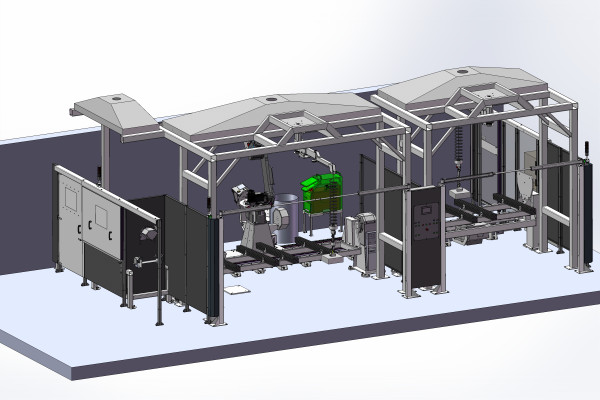
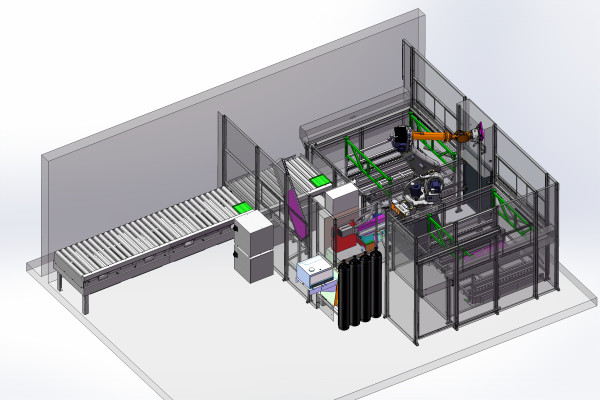
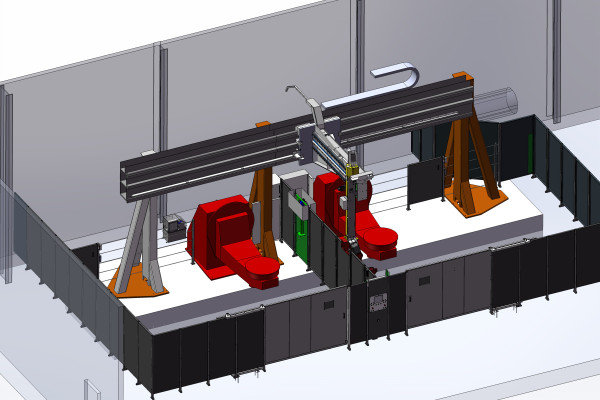
A welding cell with an overhead gantry-mounted robot and two positioners, designed for welding large workpieces.

NYTRON has many years of hands-on experience with robotic welding in production environments and can provide comprehensive technical support for the welding process. Robotic welding is a fully automated process in which industrial robots join metal components. Its high repeatability, speed, and precision make it one of the most widely used technologies in the automotive and mechanical engineering industries.
Single-station cell – a straightforward workcell in which the operator loads the components and the robot performs the welding.
Two-station cell with rotary table – while the robot welds on one side, the operator loads the next components on the other, enabling continuous operation.
Linear cell – the robot welds along extended workpieces, often using a robot travel track or a moving workpiece fixture.
Gantry cell – the robot or a gantry manipulator moves above a large welded structure.
Cell with a positioner – the workpiece can be rotated and tilted to provide optimum access to the weld joint.
Cell with a rotary table – enables fast transfer of workpieces and is well suited to series production.
Cell with robot or workpiece travel – designed for larger structures where additional motion is required.
MIG/MAG welding cell – the most common choice for carbon and stainless steels.
TIG welding cell – used for aluminum, stainless steel, and precision welds.
Laser welding cell – designed for fine, high-speed, high-quality welds.
Hybrid cell – combines multiple welding technologies.
Compact standardized cells – available with short delivery times and particularly suitable for smaller manufacturers.
Modular cells – configurable systems that can be adapted to the product.
Custom-purpose cells – engineered specifically for the customer's product and process.